
A study of film history can’t leave out the profound impact left by the French film industry. In modern times, it has continued to produce films that capture global attention and the viewer's truthful acclaim.
In 2019, one of the country’s most visionary female directors, Céline Sciamma, returned with Portrait of a Lady on Fire—a period romance set in the late 18th century, in which a painter, Marianne, is hired to secretly paint the wedding portrait of Heloise, a young woman resistant to marriage. As the two women spend time together in isolation on a remote island, their relationship deepens into a forbidden love that shapes both their lives long after their separation. It’s a film that captures the art of love and memory through the meticulous use of cinematography, narrative and technical film elements.
From the very first scene, Celine Sciamma uses clothing not as mere decoration, but as a silent language of desire, identity and rebellion. In the leads’ first encounter, Heloise’s blue hood conceals her hair, creating mystery and anticipation. When Marianne finally sees her unveiled, the exposure of her blonde hair feels like a revelation: the “art of love” unveiled through the female gaze. Marianne, by contrast, wears warm reds and maroons symbolizing her passion and the creative fire of a painter. This makes a pivotal early moment more striking: when her green dress mirrors Heloise’s, it foreshadows their deep emotional connection.
This visual echo transcends their established, consistent palettes, through Marianne’s warm reds against Heloise's cooler blues and greens. In the final concert, her red dress signifies remembrance and enduring desire—the remaining embers of the relationship still alive many years after.
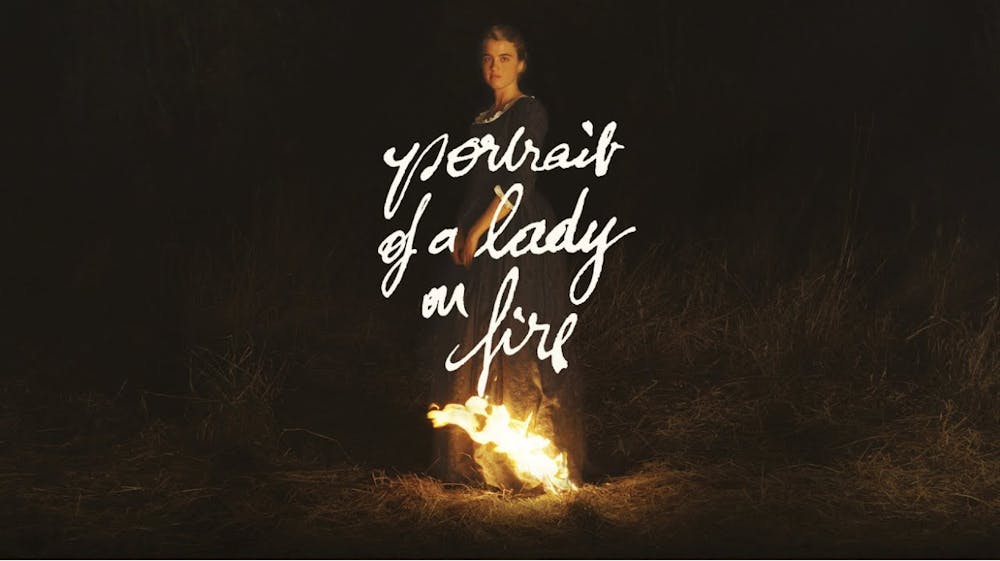
This language of color is inextricably linked to the film’s use of lighting. Just as costumes define the characters internally, the lighting plays with the constructed world they lived in. A stark contrast exists between the freedom of the island's natural daylight and the dim, candle-lit interiors, which shadow containment and secrecy. Indoors, fireplaces and candles brighten with warmth and intimacy, yet also symbolize confinement within a patriarchal system—the “light” women must create in secret. This manipulation of light peaks in the climactic bonfire scene. Surrounded by women and firelight, Heloise and Marianne are visually isolated by shadows, a dim glow on their faces. The illumination of Heloise’s dress catching fire embodies emotional ignition—a sexual desire fully realized.
The objects that fill each frame articulate the film’s deepest themes. It begins during the fireplace scene, where the placement of Marianne’s art supplies and canvases immediately defines her world. The warmth of the fire against the surrounding darkness reflects her isolation. Her nudity firmly establishes her identity not as an object of desire, but as a dedicated artist. This act culminates in a powerful act of rebellion. When Marianne secretly paints herself into the final portrait for Heloise, this is not just a hidden image, it is an act of love that defies invisibility, turning memory into a form of lasting immortality. Yet, the film is achingly aware of art's limitations. This is captured in the devastating sight of the “painting coffin,” as the hammering of the portrait into the wooden box mirrors the hammering of a nail sealing a coffin. It symbolizes the death of their affair, suggesting that while art can preserve memory, it can also become its tomb.
The careful arrangement of elements within the frame is given life through Claire Mathon’s precise cinematography. To arouse the female gaze into action, the cloak scene uses an extremely shallow focus on Heloise; the blurred background dissolves the world, emphasizing Marianne's captivated observation. This technique also serves to isolate emotion, as seen when the focus shifts from medium depth to shallow in the bonfire scene, isolating Heloise as her dress catches fire to highlight the moment's emotional intensity.
Yet, the camera's role extends beyond intimate observation of active pursuit and framing. In the running scene along the cliffs, the camera’s movement matches Heloise’s agency, overturning passive female metaphoric expression as Marianne chases after her. This portrayal of pursuit and freedom is balanced by scenes of serene equality. In the compositions of the three women working in a number of scenes, the three were seated at equal distances around a table or occupying their own spaces within a room, with the camera shooting them on the same level of ground within the frame—the cinematography visualizes a powerful theme of sisterhood and shared experience of oppression under the patriarchal structure.
The film's powerful visual language is matched by an intentional soundscape, where silence and music are used to create effect. Throughout the film, nondiegetic music was rarely used; in fact, complementary music appeared just once. The foundation of the film’s soundscape depended almost entirely on diegetic sound: the sound of nature originating from the background and of the physical interaction between props. The crash of sea waves and the crackle of fireplaces ground the film in a raw, tactile realism. This silence and use of natural sounds amplify the sincerity of the scenes, signaling the moments where music does appear transformative and critical to the point.
The first break in the silence is the bonfire chant, “Fugere Non Possum.” This is not a song, but a rhythmic ritual born from the women's own voices. It builds to a moment of raw, communal power, representing a collective female awakening. The Latin lyrics, meaning “they cannot escape” or “they come fly,” create an equivocal sense of freedom and restraint, channeling a spirit of rebellion, just as director Celine Sciamma intended.
The film's ultimate auditory symbolism is its only use of external music: Vivaldi’s “Four Seasons: Summer.” Heard years later at the concert, also serving as the final ending scene, its forceful intensity breaks the established silence and slow-flowing sadness. This sound creates a stark contrast with the film's natural soundscape, mirroring the climax of unspoken emotion between the ladies. At this moment, the music itself becomes the dialogue, articulating everything about love, loss, and memory that lies beyond the words the lovers cannot exchange.
The film's emotional authenticity is curated in the restrained and nuanced performances of its leading actresses. Noemie Merlant, as Marianne, centers her performance on the act of observation, playing the role of an observer. Her performance represents quiet internal transformation, where longing and emotional development become visible almost solely through the intensity of her gaze. In contrast, Adele Haenel’s Heloise communicates a world of feeling through subtle microexpressions—flickers of emotion that break through the surface, lighting up a journey from enforced duty to awakened desire.
Their chemistry feels less like a performance and more like a discovery. The quiet intimacy that unfolds—through shared laughter, exchanged glances, and unconsciously mirrored body gestures—builds a relationship that feels authentically tender and natural. This dynamic highlights a profound equality between them, an equal authorship over the story they are building together. Consequently, their eventual separation resonates not as a clean tragic ending, but as a permanent and haunting alteration that lingers in the rest of their lives.
At its heart, Portrait of a Lady on Fire is a story about the act of creation itself—the creation of art, love and memory in a world that denies women the right to control their own lives. The plot, a simple story of a painter and her subject falling in love, becomes a profound exploration of the female gaze. This gaze, embodied by Marianne, is not merely observational but generative. Through looking, studying, and painting, she doesn't just capture Heloise’s beauty, she helps bring her true self into a state of being.
This dynamic is solidified in the film's central motif and mythological metaphor: the myth of Orpheus and Eurydice. The myth is reinterpreted, as both women take turns playing Orpheus. Marianne looks back before leaving the residence and physically exiting Heloise’s life, condemning their love to memory. But Heloise, too, turns back—at the cliffside and in the hallway—claiming agency over her own fate and memory. This reframes their separation not as a tragic failure, but as a series of conscious, painful choices. The final, haunting question of the concert scene—did Heloise choose not to turn—elevates their story from a doomed affair to an eternal, active remembrance. If Orpheus’s choice to turn back was the decision of a poet, preserving love through remembrance and not the state of being together, what about Heloise’s?
In the end, the film argues that love and art are intertwined acts of defiance. Marianne’s final portrait, which hides her own image, is not just a token of love, but a rebellion against invisibility. Their brief affair, though ending in separation, becomes an immortal creation. The film suggests that while societal restraints can enforce physical separation, the worlds we create through memory, art, and a shared gaze are a form of liberation that lasts forever. Like Marianne and Heloise, the constraints of their time forced them apart, but the art they created granted their love eternity, defying even life's inherent ephemerality.
Portrait of a Lady on Fire endures not as a tragedy of separation, but as a triumphant feminist reimagining of the mechanics of storytelling. It counters the traditional male gaze with its consolidation of outstanding artistic expression through the female gaze, transforming it from an act of possession into one of recognition and creation. In this light, the film proposes its most essential thesis: that love, though temporally bound, can achieve a form of eternity through disparate forms of perseverance. It is immortalized not through possession, but through the art and memory it inspires, making the affair between Marianne and Heloise a permanent, slow-burning source of light.
Read More

Odessa A’zion Exiting Deep Cuts and the Absence of Latina Representation in Film
By Magdalena Johnson | Feb. 23Rewriting a Latina protagonist to fit a white lead isn’t just a casting choice; it’s a calculated erasure that forces women of color back into the sidelines. In an industry where Hispanic stars represent only 5% of roles, the fight for authentic representation is a battle to prove that our identities are not "woke" trends, but stories that deserve to be told.

Status Update: 2016 Is Back!
By Nora Diffily-Kenney | Feb. 202016 is back, and no one, not even the Kardashians, can stay away from posting old pictures—but what is actually going on? How, and why, did we go back 10 years?!

Breaking The Ice: Why ‘Heated Rivalry’ is The Cultural Power Play We Need
By Nora Diffily-Kenney | Feb. 15What began as a steamy hockey romance has become a cultural flashpoint, cracking open one of sport’s most rigidly masculine spaces. Heated Rivalry uses queer intimacy and emotional honesty to signal a powerful shift in who gets seen—and celebrated—on the ice.