
Communities tend to blossom out of niches, particularly with young women. I’ve noticed that so many of the “girl communities” we’ve cultivated as a society were born from systematic pressure, rooted in pressures to achieve, conform, and to feel worthy. These spaces often get framed as “sisterhood,” a bond built on shared experience and mutual understanding. Finding others who are just as impacted as you can serve as proof to yourself that you are not alone. It can even feel like an accomplishment, a sign that your suffering fits somewhere.
As I revisited the media that shaped my adolescence, I recognized connections between communities I once assumed were separate worlds. But under closer inspection, every one of them supports the same underlying pattern: young girls searching for belonging in places that often harm them, while pretending to protect them.
The first niche that shifted 21st century girlhood was the rise of online Pro-Anorexia communities. Eating disorders have existed for decades, but anorexia carries an isolating quality: it thrives in secrecy. Before social media, there was rarely a place where people openly shared or encouraged these behaviors. No communities of reinforcement, whether for recovery or for the disorder itself.
But once Tumblr, and later Instagram, took hold in the 2000s and early 2010s, everything changed. For teenagers struggling with body image or restrictive eating, these platforms created a parasitic ecosystem. Pro-Ana accounts posted weight-loss updates, calorie logs, “thinspo” collages and long “vent” posts discussing self-hatred and body comparisons. We even saw some beloved celebrities partaking in these trends, like Mary-Kate Olsen and Ariana Grande, blogging about goal weights, thigh gaps and restrictive dieting. Today, on Tik Tok platforms, there’s commotion across the world of Pro-Ana media resurfacing, often slipping past moderation. Adolescents are receiving eating disorder content they’d never shown interest in, causing a spiral among youth, particularly those who are in recovery.
A study done by Jacopo Pruccoli found that 64% of participants reported coming across content that encourages eating disorders without actively searching for it, and the majority (59%) of participants expressed lower self-esteem after viewing diet-related videos on TikTok. Even more alarming, the majority of youth in recovery centers still had “diet” as a top keyword in their search history, curating an algorithm that mirrors old patterns.
As a teenage girl myself, I’ve come across hundreds of these videos since I joined Tiktok. I’ve watched friends and family become consumed by it. And, what I’ve come to understand is that it feels like a family. It feels like people who are loyal to their impulses—loyal to the need to look a certain way. Being in these communities feels less isolating, and encourages you to stay. If you hit a certain weight goal and post about it, you are showered with love. If you binge and post about it, you have comment sections filled with people begging you not to give up. As terrible as it sounds, for young girls who don’t see recovery happening soon, this feels like something to never let go of. Because these are “friends,” who share your goals. At least, that’s what you’d want to think.
Enjoy what you're reading?
Signup for our newsletter
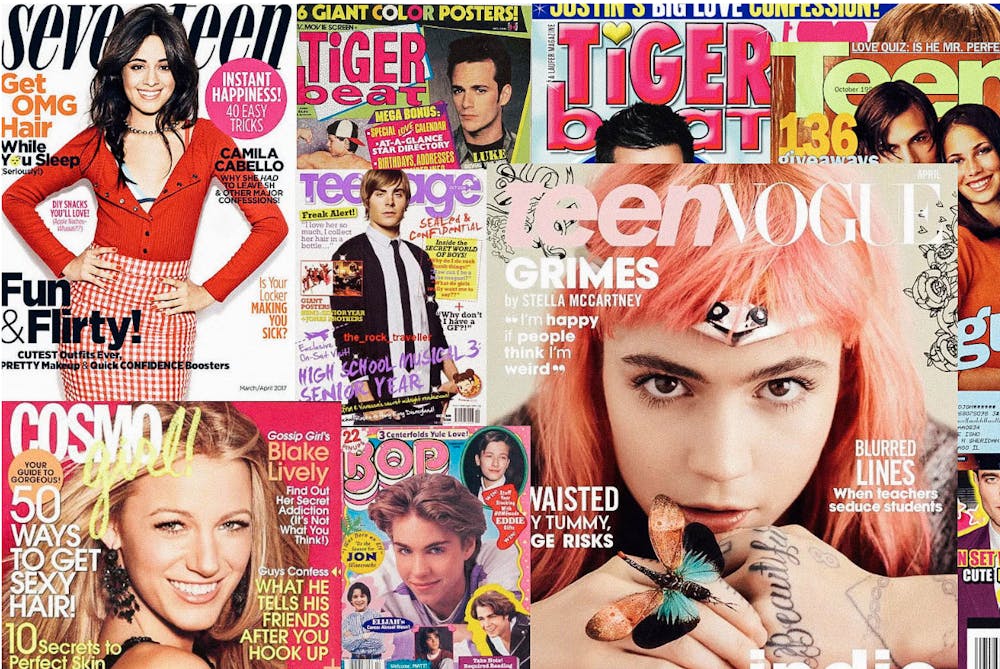
A more dated example of this pattern appeared in teen magazines. In the early 2000’s, online influencers didn’t exist. If you wanted “big sister advice” or beauty tips, you’d turn to Seventeen or Teen Vogue. These magazines were marketed as safe, girl-centered spaces. Young girls could hide away in their bedrooms, flipping page to page, thrilled to be provided with a world where girls could explore who they were becoming.
Yet, even then, the content reflected the same scripts of femininity we still see now. Headlines wrote: “The Perfect Kiss; tips you have to try!” or “What He Tells His Friends after hooking up with You!” The same topics reworked: boys, beauty, celebrity gossip, and self-improvement that solely served patriarchal standards. It was marketed as empowerment. In reality, it was training.
Two Ph.D students at Iona College, in a study analyzing the impact of these magazines wrote, “Young girls crave acceptance, and sadly, girls are often taught to attain this through unearthing the mystery of attracting boys, the art of beautification, deep knowledge of celebrity lives and various forms of submissive behavior that neglect strengthening and enriching the brain.” The constant coverage on what girls “need to know” creates a strong disconnect with actual interests or dreams of a young woman, and encourages them to engage with what publishers want them to consume.
And, it worked. It continues to work. Even if not in magazine form, the blueprint survives today. I notice myself following and subscribing to blogs, Instagram influencers, and Youtube channels sharing “girl talk” or “dating psychology.” All my friends do. It’s what we consume in our free time, and it's what we recreate in almost every conversation.
And yet, despite the embedded misogyny, these spaces still stand as “girlhood” communities.
Looking at both media niches—and my own experiences—it’s evident that communities, even when harmful or manipulative, offer something deeply human: belonging. For young girls, these communities act as gathering spaces for vulnerability, insecurity and longing. Whether the agenda is to promote a beauty ideal or sustain a cycle of self-harm, we’ve let these spaces become a rite of passage into society, that tells girls who to be long before they can figure it out themselves. Even harmful communities feel like home when the world outside them feels unforgiving. Belonging can bloom anywhere, even in the spaces that intend to break you.
Read More

Odessa A’zion Exiting Deep Cuts and the Absence of Latina Representation in Film
By Magdalena Johnson | Feb. 23Rewriting a Latina protagonist to fit a white lead isn’t just a casting choice; it’s a calculated erasure that forces women of color back into the sidelines. In an industry where Hispanic stars represent only 5% of roles, the fight for authentic representation is a battle to prove that our identities are not "woke" trends, but stories that deserve to be told.

Status Update: 2016 Is Back!
By Nora Diffily-Kenney | Feb. 202016 is back, and no one, not even the Kardashians, can stay away from posting old pictures—but what is actually going on? How, and why, did we go back 10 years?!

Breaking The Ice: Why ‘Heated Rivalry’ is The Cultural Power Play We Need
By Nora Diffily-Kenney | Feb. 15What began as a steamy hockey romance has become a cultural flashpoint, cracking open one of sport’s most rigidly masculine spaces. Heated Rivalry uses queer intimacy and emotional honesty to signal a powerful shift in who gets seen—and celebrated—on the ice.