
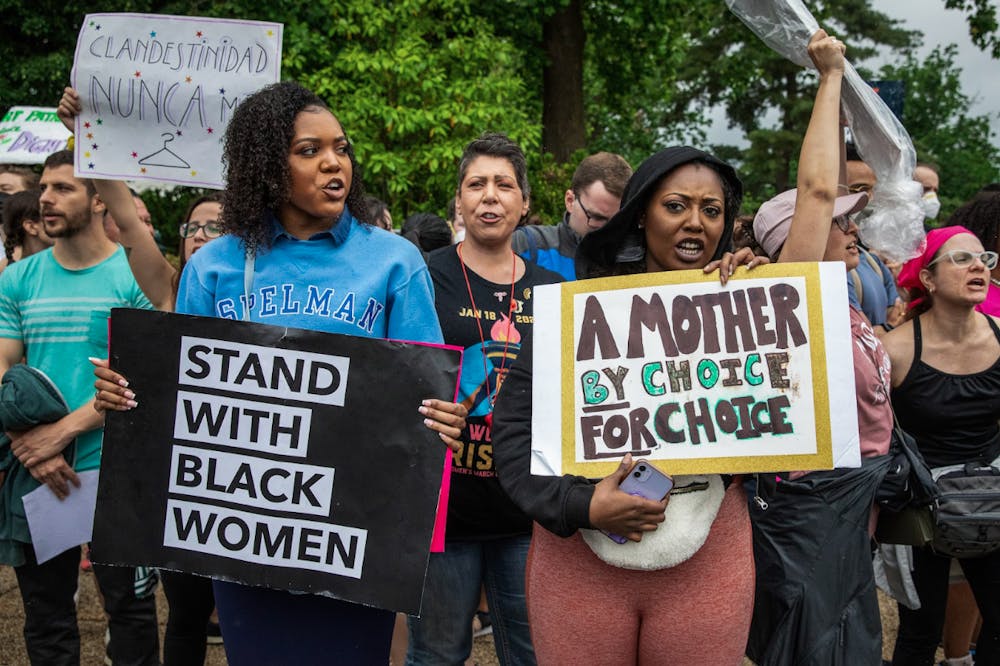
Abortion bans disproportionately hurt people of color. While debates about it are usually centered around fear, power, and education, they rarely highlight the people most affected: Black women. Restricting reproductive healthcare deepens existing racial inequalities. For instance, this restriction can worsen concrete harms like deteriorated maternal health, shortened economic opportunities, and diminished bodily autonomy. Instead of fixating on the moral status of the unborn, we must acknowledge how denying abortion access inherently perpetuates racial injustice. Protecting reproductive choice is vital to advancing racial equity.
Firstly, the argument of “pro-choice” versus “pro-life” already faces insincerity, because anything that is “pro-life” inherently sounds like “pro-death.” Coincidentally, the strongest argument for restrictive laws is the moral understanding that a fetus is constitutionally a human life worthy of legal protection, therefore painting the termination of a pregnancy as an act of injustice.
To be fair, this viewpoint—which protects what it defines as life—appeals to a genuine moral principle. However, this focus on the philosophical value of the unborn almost entirely neglects the profound suffering imposed upon the living woman, especially the Black woman, when she is forced to carry an unwanted pregnancy. In fact, research shows that these restrictive laws force doctors into impossible ethical positions and threaten the health or safety of the one in four women who will statistically need an abortion in their lifetime.
Since the Constitution cannot mandate a single moral or religious consensus on the value of fetal life, the state must and should default to protecting the established citizen, the woman. And yet, negative outcomes of abortion bans, like deepened poverty, fall hardest on Black women who already face major challenges in housing, education, and healthcare access.
Anti-abortion laws are economically unfair, especially for Black women who are often left out of the conversation. The National Institute of Health has shared that women forced to have an unwanted baby are four times more likely to be poor, to struggle to keep a job and to need more help from the government. This economic disaster is exacerbated for Black women who are more likely to live in areas with fewer healthcare options. A simple moral belief leaves a woman and her (unwanted) child worse off in real life, which leaves the heaviest burden on the most vulnerable groups in society.
Ross Douthat, a pro-life opinion columnist, states however, that “the status of women has risen in the same America where the pro-life movement has (modestly) gained ground.” What woman was the author (a white man) referring to specifically? Even more so, despite the goal of abortion bans being to “protect life,” the data damages this ideal completely. The Population Reference Bureau provides supporting statistics: Fewer children die young and are raised in poverty in states where abortion is legal. Restricting choice actively hurts a Black woman's ability to stand on her own feet, a backwards ideal that has been forced down our throats since humanity has started.
Speaking of, the most vital thing to understand about abortion is that it is undeniably healthcare, and without access to abortion and women’s healthcare, a woman's right to control her own body is taken away. The non-negotiable principle of bodily autonomy needs to be taken into account. As pro-choice activist Monica Hesse puts it, “no other law forces one person to use their body to keep another person alive.” This right is the foundation of all personal freedom in which our country says it stands on. When this right is taken away, people get hurt.
This issue is tied to the difficult but very real history in the United States, where Black women have faced both sterilization and a lack of control over their reproductive lives. Before Roe v. Wade, abortion wasn’t nonexistent. It was illegal and dangerous, forcing women to seek unsafe procedures, which guaranteed health problems and maternal deaths. Since Black women already die at high and alarming rates during childbirth, removing access to safe abortion worsens the crisis of health inequality in America. The pro-choice movement must be rooted in this reality. Protecting access means upholding a citizen's, especially those facing systemic barriers, control over her body which is necessary for her health.
For the United States to truly stand for liberty and justice for all, it must protect a woman's right to control her body, and not to sacrifice it to an abstract moral argument. When the state takes away a woman’s right to choose, it pushes an never-ending cycle of poverty, health risks, and fundamental rights taken away for Black women. Policies that worsen racial inequality and cause unnecessary deaths cannot be called pro-life or just. Ultimately, the abortion debate must move past flawed labels and moral arguments, and instead focus on the proven measurable facts that affect women everywhere. Including Black women.
Read More

Is News Destroying Us?
By Lev Weisenberg | Nov. 28Endless, sensationalized news and algorithm-driven feeds overwhelm our ability to think clearly, heighten anxiety, and distort how we see the world. As information races toward us faster than we can process it, how can anyone stay grounded and informed when the news never stops coming?

Octavia Butler’s America
By Sarah Tobacman | Nov. 12In 1993, Octavia Butler published Parable of the Sower, speculative fiction about a dystopian America. 32 years later, much of what she predicted rings eerily true. What solutions does she offer, and how could we implement them now?

Everything is Embarrassing—Or is it?
By Una Cutrone | Nov. 10The internet’s newest trend isn’t a fashion statement, it’s emotional concealment. As women hide their relationships and sincerity becomes a social risk, a generation obsessed with appearing unbothered is quietly trading genuine connection for the safety of detachment.