
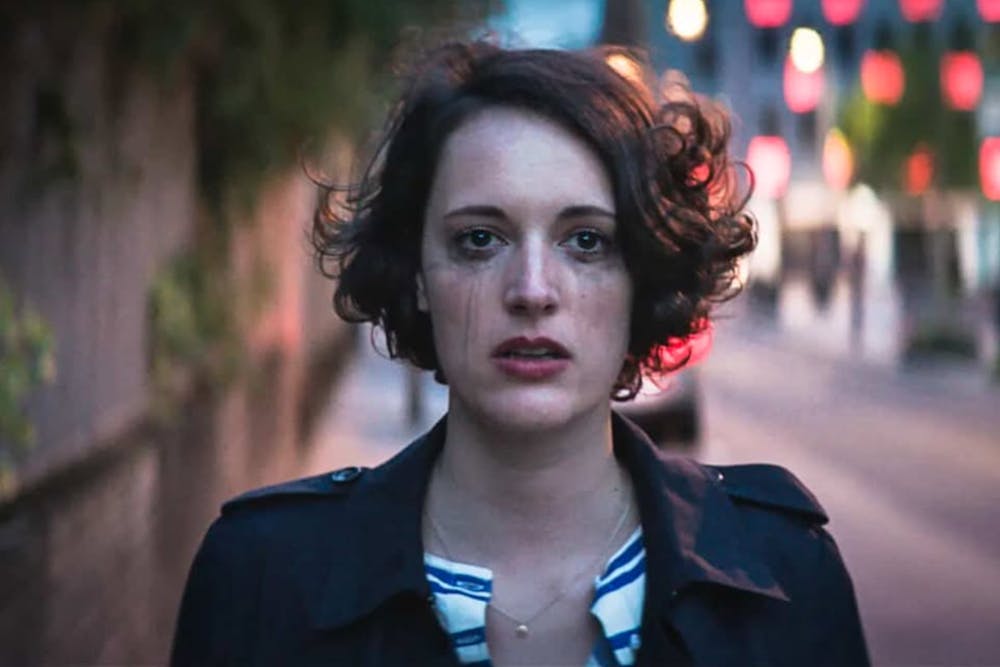
Phoebe Waller-Bride’s “Fleabag,” though not specifically drawn for adolescent viewers, presents a subtle, yet incisive example of Barbara Creed’s abject idea of the “monstrous feminine.” Creed defines the monstrous feminine as “a theoretical framework to analyze how horror films, often rooted in patriarchal anxieties, depict women as monstrous, often through their bodies, sexuality, and reproductive functions.”
Though Fleabag’s plot and characters don’t physically or overtly show monstrosity with obvious symbols such as sharp teeth or a pointed black hat, it pushes at things deeper within the idea. The show projects disruption on gender roles and customary practices of patriarchy. As a consequence, the show reaches out unknowingly to a younger, growing audience to inspire the search of identity, sexual experience, and independence.
The protagonist, who is named only as Fleabag, expresses an unapologetic embrace of her own independence; shows a completely unfiltered, bluntly honest voice in expressing her opinions aloud; and defies the societal expectation that a woman’s success is linked to her relationships with men. Most crucially, Waller-Bride pushes the narrative that women can enjoy sex, want intimacy, and express their sexuality outwardly in a space previously controlled by the dominance of a man’s desire. This sampled version of monstrosity can be defined as such because it not only challenges the cultural narrative, but more importantly, also provides the pivotal inclination for present and future empowerment of young women and female adolescents to become their own versions of monsters, in their important and difficult search for identity and voice.
Fleabag’s unfiltered honesty serves as a key component to her “monstrous persona” and further demonstrates her excellent example in the search of finding voice. This is most vividly displayed in her breakage of the fourth wall. Throughout the show’s two season run, the protagonist speaks to the audience directly quite often. For the most part, it consists of thoughts in her head and opinions about things happening around her, but occasionally, it poses questions or ideas for the audience to ponder and potentially answer for themselves. It becomes a candid expression of her inner thoughts and desires because she gives her perspective exactly how she thinks it, with no thought behind whatever emotion or reaction it may bring.
This authenticity in itself can be perceived as a form of the “monstrous feminine” as it pushes back upon previously established orders of women ‘staying quiet.’ Young women face the heavily reinforced expectation of politeness and a “hush” towards their opinions and emotions. For many, this can be frustrating and can feel claustrophobic.
Fleabag, not surrendering to the hush, touches on this by saying, “Being proper and sweet and nice and pleasing is a fucking nightmare. It’s exhausting.” She too, knows the weight of fitting in that box of staying quiet, and her step outside those lines dismantles the illusion of performance, all the while disrupting common decorum. She pushes past societal regulations and in that, proves to young women the importance of volume and empowerment, rather than their silence. Her willingness to honestly and radically expose uncomfortable hidden truths all contribute to her “monstrously” authentic character, and unknowingly create a stretched out arm, for the grasp of young, exhausted, searching minds to do the same.
Equally as important, Fleabag’s unwavering independence, established from the show’s pilot, solidifies her position in the “monstrous feminine,” and exhibits a positive, achievable example for an adolescent to follow. She navigates her life with self-reliance and autonomy, unlike the traditional caricatures of women who are completely dependent on male validation. “No, I think I'll just deal with this in my own insane, irrational, anal way, if that's OK.” This, though sprinkled with humor, encapsulates Fleabag’s volition for how she controls her narrative.
For young girls, newfound independence is a major part of gaining confidence in yourself and what will become of your identity. Even as Fleabag falls in love with a male character and feels a heavy desire for male validation, she rejects those pressures and instead, prioritizes her strong sense of self. She is not the “damsel in distress” nor the “supportive partner” archetype we all expect, and doesn’t conform to the more conventional approach of female dependence. This is significant, as for adolescents, seeing someone else do something first can serve as a catalyst for their own decisions. This makes Fleabag a clear and crucial example in developing confident self ruling practices in young females, or in other, more dramatic words, providing an example for the next generation of the “monstrous feminine.” Fleabag’s assertion of her own agency is a direct rebellion against patriarchal power dynamics, and redefines what independence can mean to all adolescents once too afraid to step outside of the previously drawn lines.
Similarly, Fleabag’s open and unapologetic articulation of her own sexuality confronts the traditional values of female desire, and asserts that young girls who crave an intimate connection should not feel shame for it. This is perhaps her most significant representation of the “monstrous feminine.” Fleabag actively and proudly identifies as a woman who seeks, enjoys, and talks about sexual experiences. Her raw discussions of sex dismantle the traditional notion of male dominance in all sexual encounters:“I'm not obsessed with sex, I just can't stop thinking about it. The performance of it. The awkwardness of it. The drama of it. The moment you realise someone wants your body.”
This display of female sexual regulation is atypical and becomes “monstrous” because in the heavily restricted framework of patriarchy, her constant thought and enjoyment of sex transgresses from the previously established order. It additionally offers up, in the birth of adolescent sexual awakening, a feeling of normalcy—and for young women being told when, where, and who they should lose their virginities to, it provides the example of autonomy to have choice in that experience. By rebelling from social routine, Fleabag seizes and reclaims her sexual identity from society, and repurposes it as a source of power, pleasure, and self for other women and adolescents to cling upon and use as a guide post for themselves.
Phoebe Waller-Bridge’s “Fleabag” offers an intensely keen reinterpretation of Barbara Creed’s “Monstrous Feminine” which, unexpectedly, because of its modernized plot and universal messages, moves into the view of female adolescents. Fleabag’s independence, her impenitent exploration and discussion of the female sexuality, and her unruly blunt honesty, all reveal how social standards and ideas render labels over women who destabilize or desert all together.
This, in itself, can be dubbed as monstrous, because it redesigns a blueprint meant for the power of one sex, stretching it to the power of two. To an even greater extent, the show’s significance lies within its ability to empower and evoke inspiration within its adolescent viewers to be authentically themselves in all forms. Whether it be from a perspective of blossoming sexual experience, growing freedom, or unapologetic expression, Fleabag, through her hilarity, vulnerability, and honesty, redefines the original “monstrous feminine,” and creates a new, even more monstrous symbol of liberation. It confronts uncomfortable issues in society, creating a lasting impact of rebellion, sense of self, and most importantly, or most terrifyingly, young female empowerment.
Read More
Education on the Line: The Ripple Effects of School Closures
By Leila Golzari-Hunt | Mar. 27As school closures loom, a growing wave of concern is building over the future of the city’s classrooms and the students caught in the middle. With many facilities already stretched to their limits, families are left questioning if these shifts will trade quality education for a system pushed far beyond its breaking point.

Odessa A’zion Exiting Deep Cuts and the Absence of Latina Representation in Film
By Magdalena Johnson | Feb. 23Rewriting a Latina protagonist to fit a white lead isn’t just a casting choice; it’s a calculated erasure that forces women of color back into the sidelines. In an industry where Hispanic stars represent only 5% of roles, the fight for authentic representation is a battle to prove that our identities are not "woke" trends, but stories that deserve to be told.

Status Update: 2016 Is Back!
By Nora Diffily-Kenney | Feb. 202016 is back, and no one, not even the Kardashians, can stay away from posting old pictures—but what is actually going on? How, and why, did we go back 10 years?!