
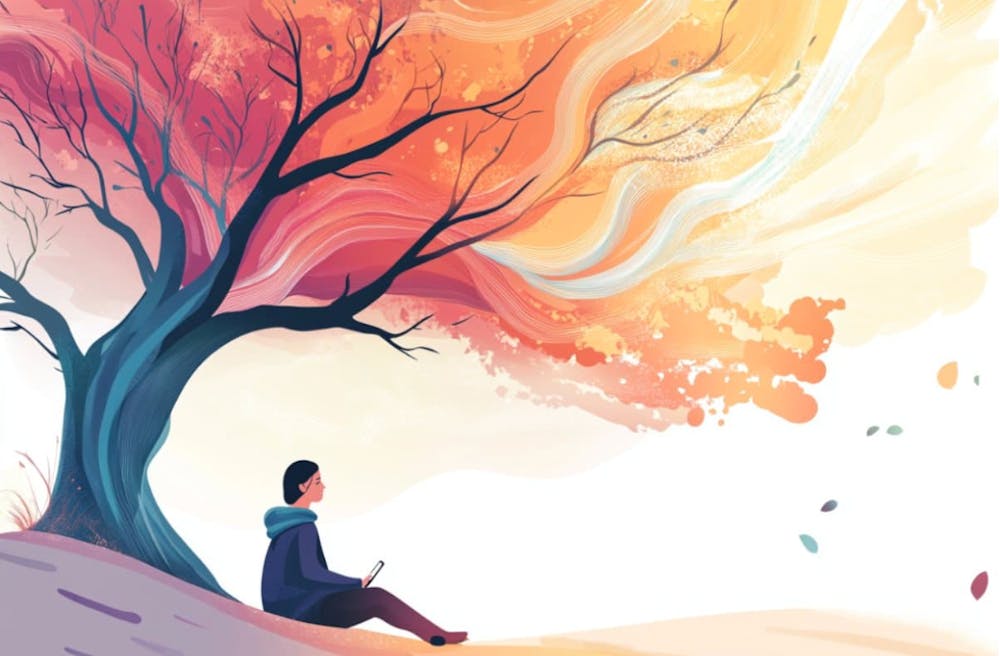
One of the most promising yet counterintuitive opportunities in our lives is hiding in plain sight: boredom. With the rush of stimulation from our phones and everyday lives, we rarely find the space to sit in silence with our own thoughts. In the digital age, one of the most significant issues we face is our inability to experience boredom. It is this inability that is responsible for the disquietude of future human innovation, joy, and life.
Boredom is undoubtedly one of the most unpleasant feelings to experience, which is why it is so frequently avoided, covered up, and painted over. The simple feeling of having nothing to do, and nothing to provide entertainment, is powerfully repelling in today’s world. “With so many forms of entertainment at our fingertips, we never need to let ourselves be bored,” says Jeffrey Davis in an article from Psychology Today. Why feel bored when we can constantly barrage ourselves with neverending content and activities?
Boredom acts as a primary catalyst for variety, driving us to seek out new and novel experiences as a fundamental human instinct. The capacity to be idle without reaching for distraction, is difficult, if not nearly impossible, for many. It’s not just the first few moments of sitting still that are hard, but rather the entire duration. The longer it goes on, the more the urges press and eventually, you cave.
In a 2014 study, researchers discovered that many people actually preferred the pain of an electric shock over the discomfort of sitting alone with their thoughts. The study describes how most only lasted 6-15 minutes in this space alone before opting to shock themselves. This is not only terribly concerning, but also deeply depressing. It’s not just attention spans that have been depleted, but the ability to recognize that sitting still is crucial.
Our minds need to wander; they need to be alone. Oftentimes we misinterpret this as us needing to be alone, but it’s really our minds that need the break. Boredom is an essential element for a person’s creative process, curiosity of the world, and motivation in life. This is proven by researchers who have shown in multiple studies that people asked to do mundane, boredom-inducing activities tended to be more creative afterwards. These studies demonstrate that boredom naturally fosters an ability to think outside the box and to bring more insight into activities, projects, or ideas.
But it doesn’t take an expert to come to this conclusion. It might have been a while since you last sat in one spot doing nothing but mindlessly spacing out, watching something in the distance, or wondering about what you had to do the next day. This is the kind of naturally-occurring mental meandering that is essential for human creativity and innovation and hence, for progress. The increase of distractions in our everyday lives (unabated access to social media or incessant music streaming) make it progressively harder to detach from these devices and give ourselves the room to actually think.
Setting ourselves apart from a given set of mainstream norms is challenging, but certainly possible. It involves resisting the urge to pick up the phone for the umpteenth time, or the desire to play music for the entire bus ride. It involves giving ourselves intentional breaks to sit with nothingness, to accept being unentertained. And it involves learning to foster real-world connections with our surroundings, others, and most importantly, ourselves.
In a world governed by corporate power, our minds are the most valuable tool we have. Utilizing our ability to appreciate the subconscious and conscious wanderings of our brains is one of the most effective ways we can implement focus and flow into our everyday lives, ultimately leading us on a path towards lives of personal and social success. Accessing our own brains does not by any measure mean scrolling for hours, but to the same extent does not mean overloading ourselves in desperate hopes of being successful. Sometimes the most effective way to make progress is by periodically not doing.
Read More

The Importance of Empathy in the Current Era
By Leila Golzari-Hunt | Feb. 19When political labels are weaponized to justify violence and strip victims of their dignity, we trade our shared humanity for partisan warfare. Reclaiming empathy is no longer just a moral choice—it is a desperate necessity to stop a culture that has become dangerously desensitized.

Black Girls Deserve Vulnerability—SZA Said it First
By Qitanah Pettiway | Feb. 13In a world that demands Black girls be strong and silent, SZA’s album, Ctrl, feels like a quiet rebellion. Explore how the popstar’s embrace of vulnerability carves out space for a new generation of Black women to exist freely, honestly, and on their own terms.
Forget Resolutions: Here’s How You Can Start 2026 Right
By Natalie Spina | Feb. 9Stop chasing a performative "New Year reset" that is practically designed to fail. Real transformation begins by trading loud, unrealistic resolutions for the quiet, sustainable habits that actually survive past January.