
The fairy tales we know today—sanitized, animated, and embellished with guaranteed happy endings—are very far from their origins. These stories were not born in a nursery or as bedtime stories for toddlers, but around the firesides of peasants and in the salons of aristocrats, serving as the dark reflections of the hardships and fears of pre-industrial Europe. Their original stories served as moral compasses for a dangerous world, often carved from the raw timber of survival, betrayal, and violence. Perhaps the most profound irony is realizing how closely our youngest children, in their greatest state of innocent purity, have touched upon some of humanity's most cynical truths.
Consider the pervasive themes that underpin the classic folklores. The deep, predatory forest in Hansel and Gretel or The Little Red Riding Hood wasn't an element of literary setting; it was a very real threat on the edge of medieval villages—a place of wolves, outlaws, and the unknown.
The common trope of the wicked stepmother was a direct reflection of the high mortality rates during childbirth. A new wife entering the household often meant a brutal competition for resources, threatening the children of the first marriage—a chilling economic and emotional reality disguised as fantasy.
The narratives themselves were brutally direct. In early versions collected by scholars like the Brothers Grimm or Italy’s Giambattista Basile, punishments were visceral and symbolic. The evil queen in Snow White was forced to dance in red-hot iron shoes until she died. Cinderella’s stepsisters, in the Grimm tale, had their eyes pecked out by birds. These weren’t arbitrary acts of cruelty but poetic justice, presenting a stark, clear line between good and evil—something that is so often blurred in the complex reality of human nature.
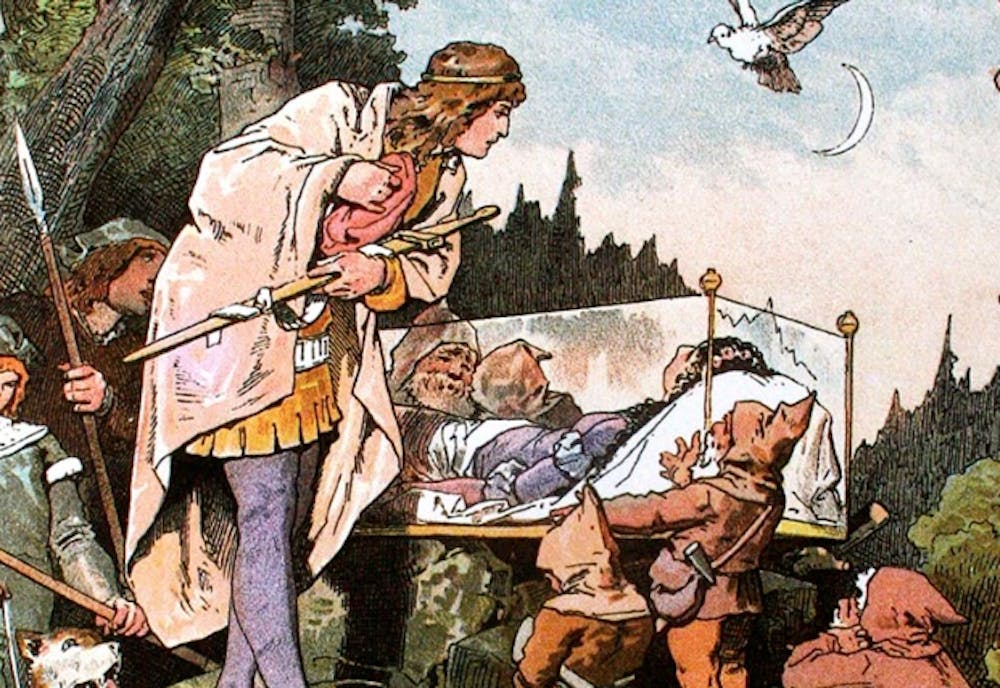
This darkness extends profoundly to the romances we now consider archetypal. The love in these stories was often far from a meeting of minds or understanding from hearts. Take Snow White, for example: the prince’s encounter begins with a stumble upon a glass coffin. He is struck not by her personality, but by her lifeless beauty, and he falls in love with her corpse—a dynamic modern psychology would classify as necrophilia—a paraphilia of sexual attraction or activity involving corpses. These elements were not seen as romantic, but as extreme narrative devices highlighting paranormal obsession, exploitation of power, and the commodification of beauty.
These stories functioned as essential, grim, and cautionary tales. They prepared children for a harsh world by embedding lessons in unforgettable, terrifying imagery. The Little Red Riding Hood warned of the seductive danger of strangers, while Bluebeard served as a stark lesson about curiosity and the deadly secrets a husband might keep. These tales gave form to abstract fears, making them digestible through story, while simultaneously reinforcing social norms and the perils of transgressing them.
The transformation of these dark folktales into children’s bedtime stories is a fascinating process of cultural influence. In the 17th century, French writer Charles Perrault adapted stories for the aristocratic court, smoothing edges and adding refined morals. The Brothers Grimm, in the 19th century, famously collected German folklore but progressively revised their editions, softening violence, removing sexual references (like Rapunzel’s pregnancy), and repositioning mothers as stepmothers to make them more acceptable for the typical family market. The troubling romance of Snow White was reframed as a miraculous awakening.
This sanitization, however, could not fully erase the power of the core narratives. The enduring appeal of fairy tales lies precisely in this shadowy foundation. They grapple with fundamental human experiences: jealousy, abandonment, the struggle and competition for resources, and the journey from innocence to experience. The darkness provides the stakes, making any final triumph feel earned rather than simply granted.
Modern stories keep returning to this original darkness. From the rewritten fairy tales of author Angela Carter, to the darker movies like Pan’s Labyrinth or shows like Grimm, we are pulled toward the mature and unsettling ideas inside these stories. They show that fairy tales are not just for kids, but are strong, changing tools we use to look at the deepest and longest-lasting shadows in human life.
Because of this, the famous “happily ever after” is actually a fairly new addition from recent times. A more honest beginning for these tales would be the whispered line, “Once upon a time, in a world of very real dangers…” It is this history of darkness—of bare survival, unfairness, and twisted longing—that makes the brighter, invented ending feel powerful and lasting, even if that power is complicated. These realizations also prompt new ways of thinking about classic tales. Happy endings can be seen as a fragile, desperate fiction, painted thinly over a void where no mercy was ever found. Thus we are left to question the true intentions of societal censorship: what are we truly hiding from our children, our purest selves—the rotting of the world, or the rotting within ourselves?
Enjoy what you're reading?
Signup for our newsletter
Read More

Odessa A’zion Exiting Deep Cuts and the Absence of Latina Representation in Film
By Magdalena Johnson | Feb. 23Rewriting a Latina protagonist to fit a white lead isn’t just a casting choice; it’s a calculated erasure that forces women of color back into the sidelines. In an industry where Hispanic stars represent only 5% of roles, the fight for authentic representation is a battle to prove that our identities are not "woke" trends, but stories that deserve to be told.

Status Update: 2016 Is Back!
By Nora Diffily-Kenney | Feb. 202016 is back, and no one, not even the Kardashians, can stay away from posting old pictures—but what is actually going on? How, and why, did we go back 10 years?!

Breaking The Ice: Why ‘Heated Rivalry’ is The Cultural Power Play We Need
By Nora Diffily-Kenney | Feb. 15What began as a steamy hockey romance has become a cultural flashpoint, cracking open one of sport’s most rigidly masculine spaces. Heated Rivalry uses queer intimacy and emotional honesty to signal a powerful shift in who gets seen—and celebrated—on the ice.